
Children's dentist · New Belgrade, Block 45
Children's dentist in New Belgrade the one your child opens up to
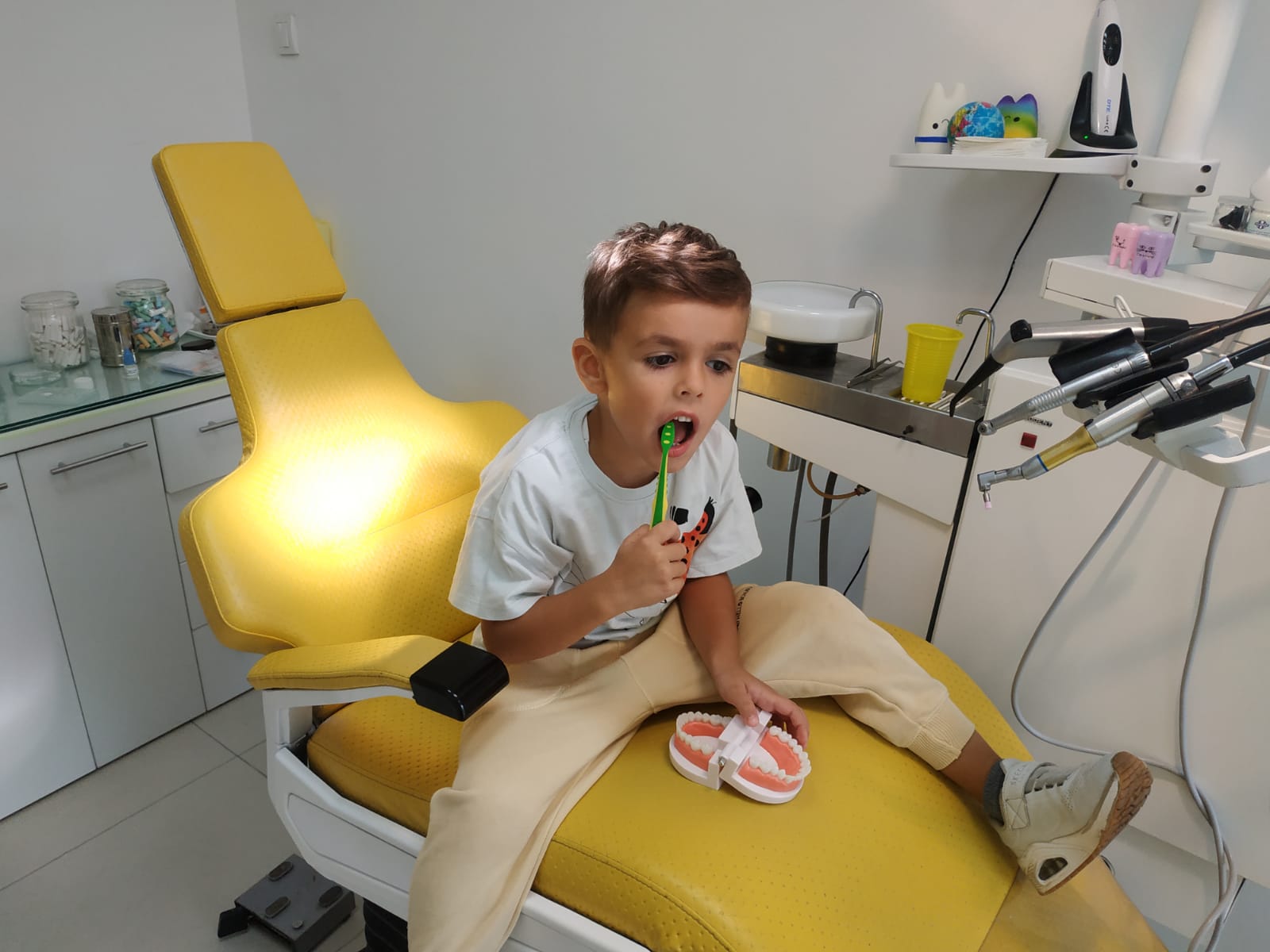
Dr Tanja Ninković works with children without rushing: first we get to know each other, then we look at the teeth. If a child is in pain or has had an injury, we see them the same day while the practice is open.
Free first examination + a written plan
After the examination you know what needs treating, in how many visits and at what fixed price — with no hidden costs.
- Same day for a child in pain
- No rush and no pressure
- Jurija Gagarina 219A, Block 45
4.9 · 94 reviews
What parents say
Two reviews from our Google listing — about the approach to children and about being seen the same day.
4.9 · 94 Google reviews
“Dr Tatjana is the only one my son happily opened his mouth for, and he loved her at first sight. She is positive, a real fighter, she does not give up, and she is much more than a top-level professional. I am delighted and will recommend her to everyone — she has a special gift for working with small children and with a big mum :)”(translated)
Original review in Serbian:
Doktorka Tatjana je jedina kojoj je moj sin rado otvorio usta i koju je zavoleo na prvi pogled. Pozitivna je, veliki je borac, ne odustaje i mnogo je više od vrhunskog stručnjaka. Ja sam prezadovoljna i preporučivaću je svima, a ima poseban dar za rad sa malom decom i velikom mamom :)
Irena Diklić
2 years ago
“The doctor saw us the same day I called, because it was a filling for a six-year-old child. I do not know what was at a higher level — the approach, the kindness, the focus, the professionalism or the top-level service. Wholehearted recommendation.”(translated)
Original review in Serbian:
Doktorka nas je primila isti dan kad sam je pozvala jer je u pitanju bila popravka zuba detetu od 6 godina. Ne znam šta je bilo na višem nivou - pristup, ljubaznost, usresređenost, profesionalizam ili vrhunska usluga. Preporuka od srca.
Milica Guberinić Tanasijević
3 years ago
What parents most often come with
Baby teeth are not temporary: they hold the space for the permanent ones, they affect speech, and they decide whether a child chews on both sides.
A first check-up
Nothing hurts, but you want the child to see the practice and get to know it — before a problem appears.
Decay in a baby tooth
A dark spot, a hole, or pain with sweet and cold. A baby tooth is treated — it does not have to come out straight away.
Pain and swelling
The child cannot sleep for the pain, the cheek is swollen, or there is a fever. Do not wait with this — call the same day.
A fall or a dental injury
A broken, displaced or knocked-out tooth after a fall or a blow. What to do in the first 30 minutes is below.
Removing a baby tooth
When a tooth cannot be saved or it is time for it to go, we remove it with preparation and an explanation for the child.
Advice on hygiene and diet
How often, which toothpaste, bottles and sweets — a short conversation that prevents the next filling.
What the first visit looks like
The first visit is often not a treatment. The goal is that the child leaves without fear and that you know where you stand.
The child chooses where to sit
Alone in the chair, on your lap, or standing next to it. We do not insist on the chair if the child does not want it.
Getting acquainted, no instruments
First we talk to the child, show the little mirror and say what we are going to do. No surprises.
An examination without rushing
We look at the teeth, the gums and how the teeth bite. If the child needs to get used to it, we stop and continue another time.
A plan for the parent
We say what needs treating, what can wait and what comes first. If nothing needs doing — we say that too.
Tips for parents before you come
Most of it depends on how the child experiences the first visit. This helps more than anything we can say in the practice.
- 1
Book a time when the child is rested — mornings are usually easier than nap time.
- 2
Tell the child a day before, briefly and calmly: “we are going to count your teeth”. No details about pulling or drilling.
- 3
Do not promise “it will not hurt” if you do not know what will be done. Say: “if anything feels unpleasant, we will tell you first”.
- 4
Do not retell your own bad experiences with dentists in front of the child, not even as a joke.
- 5
Do not use the dentist as a threat (“if you eat sweets, the dentist will…”).
- 6
Bring the child’s favourite toy or blanket — a familiar object helps them settle.
- 7
If the child has had a bad experience or is very anxious, tell us on the phone. We will adjust the pace and the length of the visit.
- 8
Let the child eat before you come — a hungry child has less patience.
- 9
Afterwards, praise the effort rather than the “bravery”: “you were calm while we counted your teeth” helps more than “well done, you did not cry”.
When not to wait for an appointment
These are the situations where you call the same day, while the practice is open. You do not have to be sure it is an emergency — call and ask.
Pain that wakes the child
Pain that does not ease with a syrup or tablets used as directed, or a child who cannot sleep because of it.
Swelling of the face or gum
A swollen cheek, a swollen gum or pus — swelling in a child should not wait.
Fever together with toothache
A temperature and toothache together can mean an infection that is spreading.
A fall or a dental injury
A broken, displaced or knocked-out tooth, or a cut on the lip and gums.
Bleeding that does not stop
If bleeding after an injury does not stop with a few minutes of pressure.
If a tooth has been knocked out — the first 30 minutes matter
- Permanent tooth: hold it by the crown, not the root. Rinse it with milk or saline (not tap water), then carefully put it back in the socket, or keep it in milk and come immediately.
- Do not put a baby tooth back in the socket — you can damage the permanent tooth growing underneath. Put it in milk or saline and call us.
- Do not scrub or brush a knocked-out tooth.
- Keep a broken piece of a tooth and bring it with you.
This is general first-aid advice, not a substitute for an examination. With children it is always better to call as early as possible.
What affects the cost of children's dental treatment?
The cost depends on what is being done, on how many teeth and on how many visits are needed. That is why we give it in writing, after the examination — the same principle applies to children.
Whether the tooth is treated or removed
Repairing a baby tooth and removing it are not the same procedure. The decision depends on how damaged the tooth is and how long it has to last until the permanent tooth comes through.
Number of teeth
One tooth or several — the plan always lists each tooth separately.
Whether an X-ray is needed
Sometimes the decision is made from the examination alone; sometimes an X-ray is needed.
How many visits a child can manage
With a small child we often work in shorter visits. That is part of the plan, not a surprise.
The state of the other baby teeth
If there is more than one cavity, the plan is made for the whole picture, not tooth by tooth.
After the examination you receive a written plan: which tooth, what is being done, in how many visits and at what fixed price. If something outside the plan turns out to be necessary, we tell you before we continue.
Your dentist
dr Tanja Ninković
Frequently asked questions from parents
When the first tooth appears, and no later than the first birthday. At that age the examination is short and simply lets the child get used to the practice — and problems are easiest to prevent then.
Yes. A baby tooth holds the space for the permanent tooth, affects speech and chewing. If decay is not treated, it can lead to pain, swelling and losing the tooth too early.
That is common and expected. We do not force it: we stop, talk, and try again another time. A short, calm first visit is better than a child who is frightened of the practice.
Yes. The parent stays in the room, and we agree on where the child is most comfortable — on your lap, next to the chair, or alone in the chair.
If a child is in pain, has swelling or has had an injury, call — we see them the same day while the practice is open. The exact time depends on how full the day is.
We use local anaesthesia when it is needed, and we explain to the child what is coming first. Afterwards there may be mild sensitivity, which usually settles within a day.
The first examination is usually short. Treatment later depends on what is being done; with a small child we work in shorter visits.
Book a first visit for your child
Call us or send a message — we find a time that suits the child, and if there is pain, we see them the same day.
Or call now
064/3-926-926Prefer Viber over WhatsApp?